
Ask a child to define an ecosystem and many will recite a textbook line word for word. Ask the same child why a pond changes when its frogs disappear, and the answer often goes quiet. That silence tells us something important: the child has memorised the topic, but has not yet understood it.
At The Link School System, we believe that meaningful education goes beyond textbooks. One of the ways we put this belief into practice is through concept-based learning — an approach that helps students understand ideas deeply, connect them to the world around them and use them with confidence. In this article, we explain what concept-based learning is, why it matters, and how it looks inside a classroom, using a familiar science topic — ecosystems — as our example.
The Problem with Learning by Heart Alone
Memorisation has its place. Multiplication tables, spellings and key definitions are useful tools. The difficulty begins when memorisation becomes the goal rather than a tool. A student who learns only by repetition can often reproduce an answer in an examination, yet struggle when the same idea appears in a new form, a different question or a real-life situation.
Understanding, on the other hand, travels. When a student truly grasps why something happens, that knowledge can be applied, explained to others, questioned and built upon. This is the kind of learning that lasts beyond the examination hall.
What Is Concept-Based Learning?
Concept-based learning organises teaching around big ideas rather than isolated facts. Facts are still taught — but always in relation to a central concept that gives them meaning. In the topic of ecosystems, for example, the big idea is interdependence: living things (biotic factors) and non-living things (abiotic factors) such as sunlight, water and soil all depend on one another. Once students understand this single idea, food chains, habitats and environmental change stop being separate chapters and start making sense together.
Below are five classroom practices that bring this approach to life.
1. Start with the Big Idea
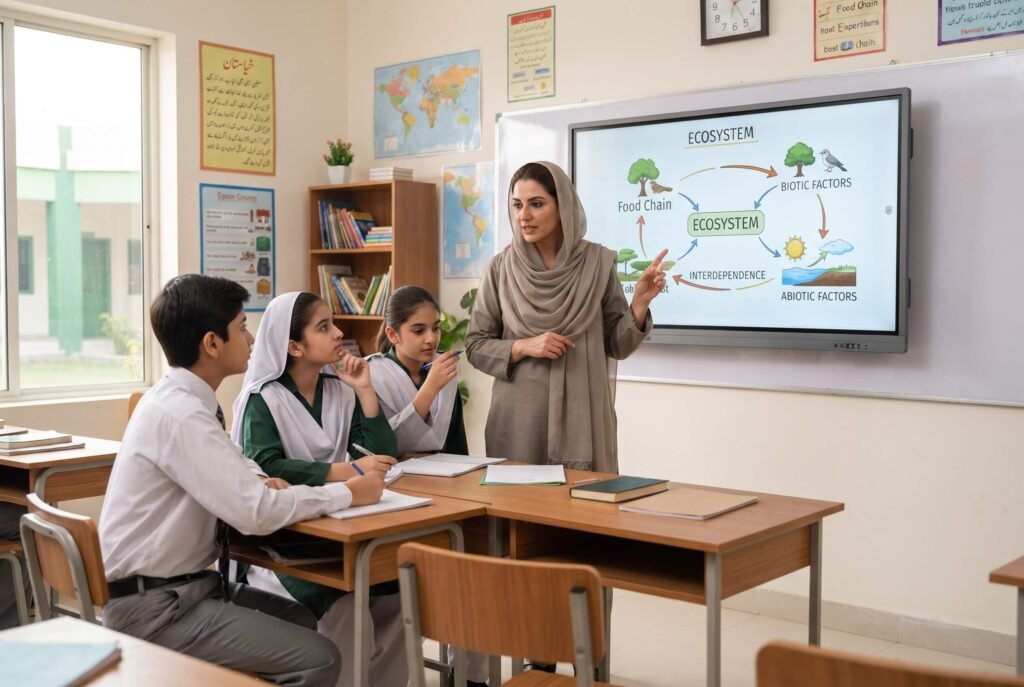
A strong lesson begins by showing students where they are going. Instead of opening the textbook at the first definition, the teacher presents the whole picture — a clear visual of how the parts of an ecosystem connect. Students see the destination before the details, so every new fact has a place to belong.
Visual learning plays a key role here. A well-designed diagram can show in a few seconds what a page of text struggles to explain: the arrows of energy moving through a food chain, or the sun and water supporting plant life. Visuals do not replace explanation; they give explanation a framework.
2. Make Thinking Visible with Concept Maps
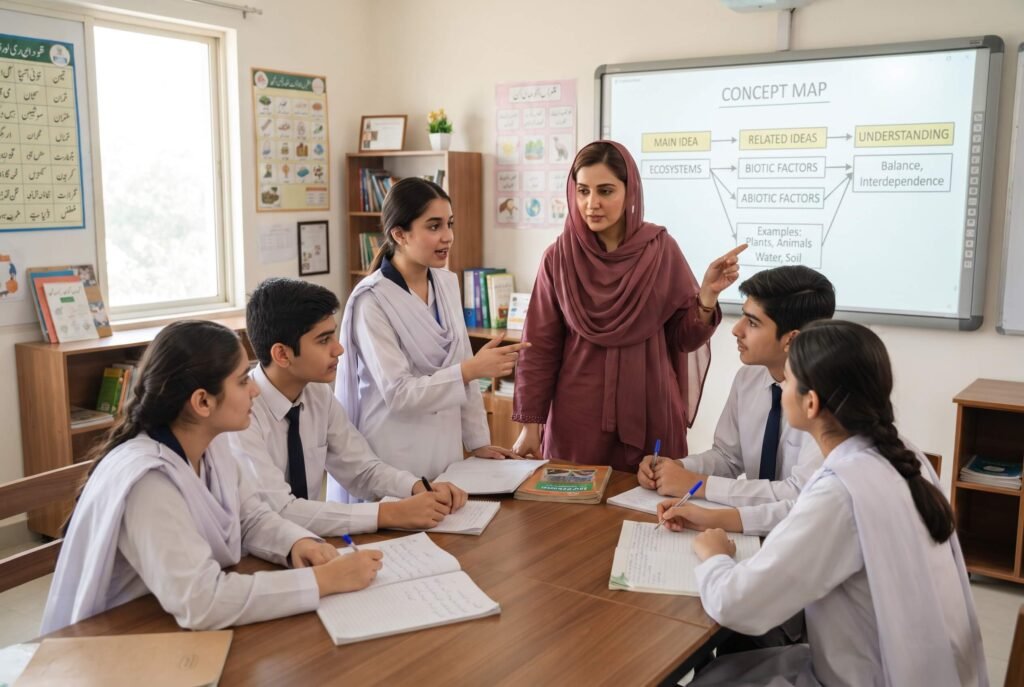
A concept map is a simple but powerful tool. Students place the main idea in the centre, then connect related ideas with arrows and short phrases that explain the link: Ecosystem → Biotic factors → Plants and animals; Ecosystem → Abiotic factors → Water and soil; and finally, both → Balance and interdependence.
When students build these maps in small groups, something valuable happens: they must explain their reasoning to one another. A student who says, “This arrow goes here because…” is not repeating — they are thinking. And for the teacher, a concept map shows instantly where understanding is strong and where a misconception needs attention.
3. Connect Learning to Real Life
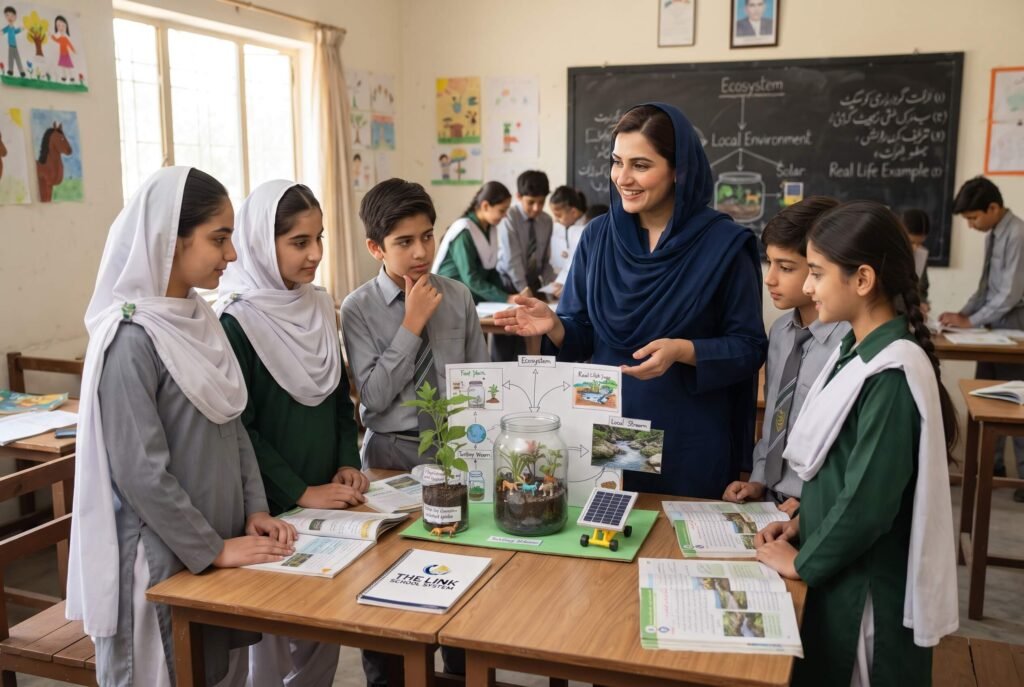
Children understand best what they can see, touch and recognise. A sealed jar with soil, small plants and water becomes a miniature ecosystem students can observe for days. A photograph of a local stream, a plant growing in the classroom or a small solar model turns abstract terms into something real.
Real-life connections also help students care about what they learn. When they discover that the same principles of balance apply to the canal near their neighbourhood or the park they visit, science stops being a subject in a book and becomes a way of understanding their own world.
4. Learn by Doing: Hands-On Inquiry
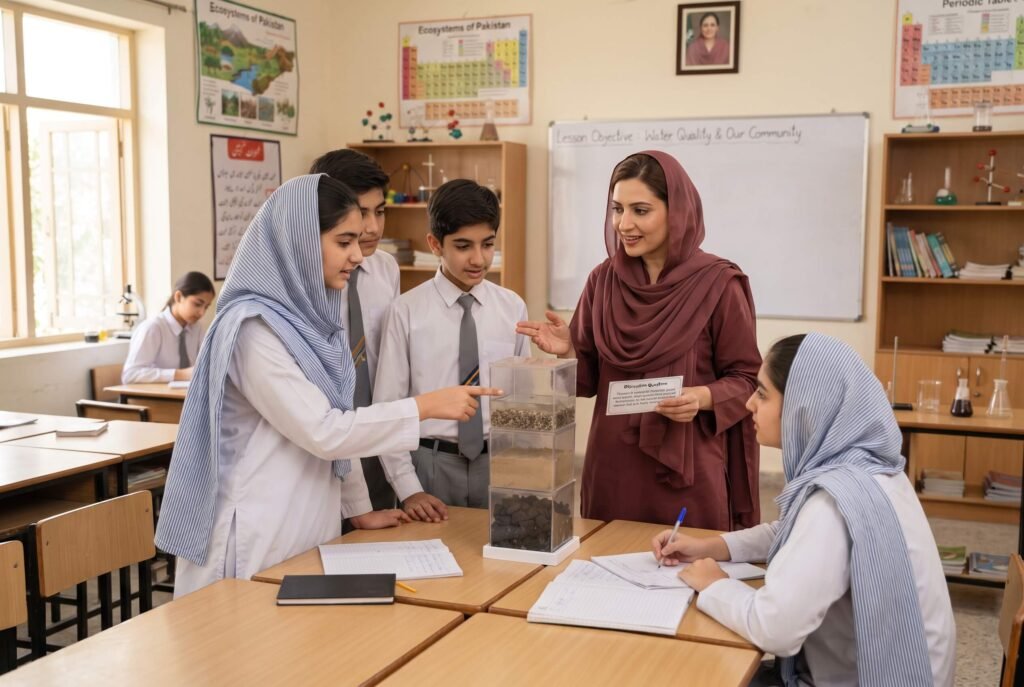
Inquiry-based activities invite students to investigate rather than simply receive information. Consider a simple water filter built from layers of gravel, sand and charcoal. Students predict what will happen, pour muddy water through it, observe the result and then discuss why each layer matters. Along the way they meet ideas about water quality, natural filtration and how communities depend on clean water.
The teacher’s role in such activities shifts from “the person with all the answers” to “the guide who asks the right questions”. Questions such as What do you notice?, What might happen if…? and How could we test that? build curiosity, observation and reasoning — skills that serve students in every subject.
5. Encourage Questions and Active Participation

A classroom where students raise their hands to ask — not only to answer — is a classroom where learning is alive. Interactive learning means creating an environment in which questions are welcomed, mistakes are treated as part of learning, and every student feels confident enough to participate.
Discussion, pair work and short presentations give students regular opportunities to put ideas into their own words. Explaining a concept to a classmate is one of the most effective ways to understand it — and it builds communication skills and confidence along the way.
Assessment That Checks Understanding
If we teach for understanding, we must also assess for understanding. Alongside traditional tests, short quizzes and classroom questions can ask students to explain, compare, predict and apply — for example, “What might happen to a pond if all its plants were removed?” Regular assessment of this kind helps teachers identify areas for improvement early and helps students see their own progress.
How Parents Can Support Concept-Based Learning at Home
Parents play a vital role in a child’s learning journey. A few simple habits at home can strengthen what happens in the classroom:
- Ask “why” and “how” questions. Instead of “What did you learn today?”, try “Can you explain how that works?”
- Let your child teach you. Asking a child to explain a lesson to you is a powerful way to strengthen understanding.
- Connect lessons to everyday life. A walk in the park, a kitchen garden or the water tank at home can all become learning moments.
- Value effort and curiosity, not only marks. Praise good questions and careful thinking as much as correct answers.
- Stay connected with the school. Regular communication with teachers helps you understand your child’s progress and support it at home.
Conclusion: Building Learners for Life
Education is not only about remembering information until the next examination. It is about helping children think clearly, ask good questions, make connections and apply what they know with confidence. Concept-based, interactive and visual learning — supported by regular assessment and a strong partnership with parents — helps students build this kind of lasting understanding.
At The Link School System, our goal is to create a supportive learning environment where students can develop knowledge, confidence, character and the skills they need for their future. Because when understanding grows, so does the learner.
Together We Link, Together We Grow.